
Motus Wildlife Tracking Is Revealing Bird Movements Across the Central Valley
Motus (Latin for movement) is an apt name for a technology that is transforming our understanding of how birds, bats, and butterflies navigate the landscape. The Motus Wildlife Tracking System, a program of Birds Canada, is a global collaborative research network designed to advance the study of wildlife movement. For bird conservationists working in the Central Valley, it’s a gamechanger for tracking wildlife. And CVJV Management Board member organization River Partners is playing a key role in expanding the use of this new technology in the Central Valley.
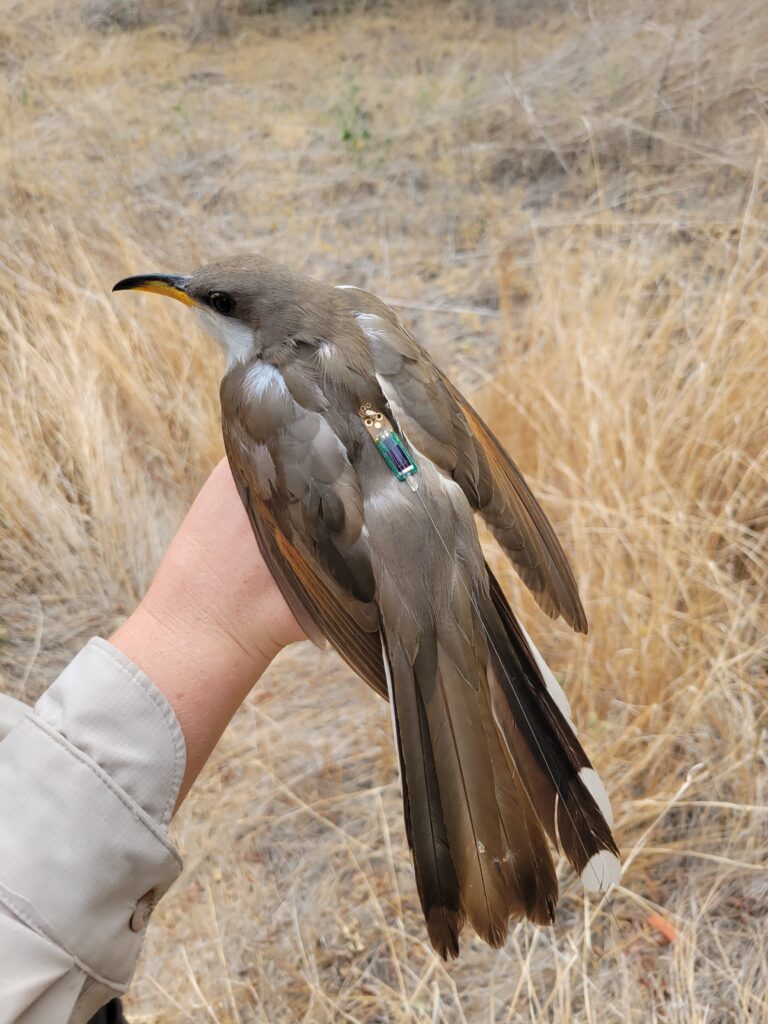
The system works by attaching small, lightweight radio tags to animals, tags weighing as little as 0.2 grams for birds and an extraordinarily delicate 0.06 grams for butterflies. These tags continuously emit a unique radio signal every few seconds. When a tagged animal passes within range of a Motus receiver tower, which can detect signals up to 9 to 12 miles away with a clear line of sight, the tower logs the tag’s unique ID, the date, time, and signal strength. That data is automatically uploaded to a shared international database. The result is a passive, continuous monitoring system that replaces the painstaking, hit-or-miss process of traditional bird banding, where a researcher might band thousands of birds over a career and receive confirmed recapture data on only a tiny fraction of them.
The power of Motus grows with its network. As of May 2026, 2,399 stations have detected 488 species across 34 countries. California leads the U.S. with 141 stations and detections of 48 species. When data points from hundreds of towers along migratory paths are pooled, researchers can answer questions that were previously out of reach: How long do these animals live? How much time do they spend at stopover sites? What habitats do they rely on outside of the breeding season? Each new tower fills in gaps and clarifies data collected across the entire network, benefiting research far beyond the organization that installed it.
These shared benefits are clear in the Central Valley, where some species are in serious trouble. The tricolored blackbird, an at-risk species listed as Threatened under the California Endangered Species Act, has lost more than 95% of its population in the San Joaquin Valley. While researchers have developed a solid picture of where these birds breed, their movements during fall and winter remain poorly understood. Motus can help to fill those gaps. River Partners installed Motus stations earlier this year at Dos Rios State Park and Panorama Vista Preserve. These sites are strategically positioned to fill a 100-mile gap in Motus coverage along one of the most important migration corridors in California. Among numerous other species, the towers detect tricolored blackbirds as they move between the Sacramento and San Joaquin Valleys.
In fact, the Motus station at Panorama Vista Preserve has tracked two separate tricolored blackbirds, and one of them has traveled from Bakersfield to just south of Chico.
The CVJV’s award-winning Motus Avium video features one tracking project looking at the impacts of drought on migratory shorebirds, including on their movements within the Valley. This project could help the CVJV direct conservation dollars to specific basins where they’ll be most useful.
As conservation challenges grow larger and resources remain finite, tools like Motus represent a smarter path forward. By revealing where wildlife goes through the seasons, what habitats they depend on, and how they respond to restored landscapes, the network helps direct conservation investments where they matter most, meeting bird populations’ full lifecycle needs. In the Central Valley, a landscape shaped by centuries of human-caused transformation and now under increasing pressure from drought and a shifting climate, this kind of efficient data collection is exactly what bird conservation needs.
Top image: Yellow-billed cuckoo with Motus tag, Annie Meyer, Southern Sierra Research Station